Gemological grading for the lab-grown era Mon–Fri 9:00–5:00 ET New York Metropolitan Area Client Intake
Science & Technology

Grades are measured before they are judged.

Every stone that enters the laboratory is scanned, weighed, and screened by instruments before a grader ever picks it up. The human eye decides; the machines make sure it decides from facts.

Instrument
Schedule

The instrument schedule IGML is being commissioned against. Each is calibrated on a documented schedule, and calibration records are retained. The laboratory is being fitted out now; see Standards & Disclosure for commissioning status.

InstrumentFunction
Non-contact optical scannerCaptures the full three-dimensional geometry of every facet to the micron. Feeds measured proportions, symmetry analysis, and computed light performance.
SpectrophotometerUltraviolet–visible spectral screening in support of identity, color type, and treatment detection.
Electrical & thermal multi-testerConfirms diamond identity at intake and separates diamond from moissanite and other simulants before anything else happens.
Master stone setsGraded comparison stones for D–Z color calling under standardized viewing conditions. Color is never graded from memory.
Standardized illuminationDaylight-equivalent grading lamps in a neutral gray environment, so a grade called on Tuesday means the same thing on Friday.
Precision balanceCarat weight measured to the thousandth of a carat for every loose stone.
Stereo microscopy, 10×–60×Darkfield examination for clarity grading and the plotting of internal characteristics.
Laser inscription systemMarks the report number on the girdle, binding the stone to its registry entry for life.
Light return Contrast Leakage Computed from measured geometry · IGML2600147PX

Computed light performance

Because every stone is scanned to the micron, the laboratory does not have to guess how a diamond handles light. From the measured geometry we compute the stone's optical behavior: brilliance (how much light returns to the eye), fire (how it disperses into color), scintillation (the pattern of sparkle in motion), and contrast (the structure that gives a stone its crispness).

The result is a light performance map of the actual stone, not a stock illustration: where light returns, where it creates contrast, and where it leaks. Two diamonds with identical 4Cs can map very differently, and the map shows your customer why one costs more.

Light Performance Analysis is available as an add-on to any diamond grading report, and the map prints on the report itself.

Spectral screening

Every diamond has a spectral signature: the pattern of wavelengths it absorbs and transmits. The laboratory records that signature for every submission and reads it in support of three questions that the eye cannot answer: is this diamond, how was it grown, and has it been treated after growth.

Stones whose spectra do not support their stated identity are stopped at screening, documented, and returned. This is the step that makes the words on the report mean something.

Spectral screening is included with every report, at every tier. It is never optional, for any client.

400 500 600 700 nm Absorbance type-defining band sample reference
Measured,
Then Judged

Machines measure. Gemologists judge. A grade is authorized only when both agree.
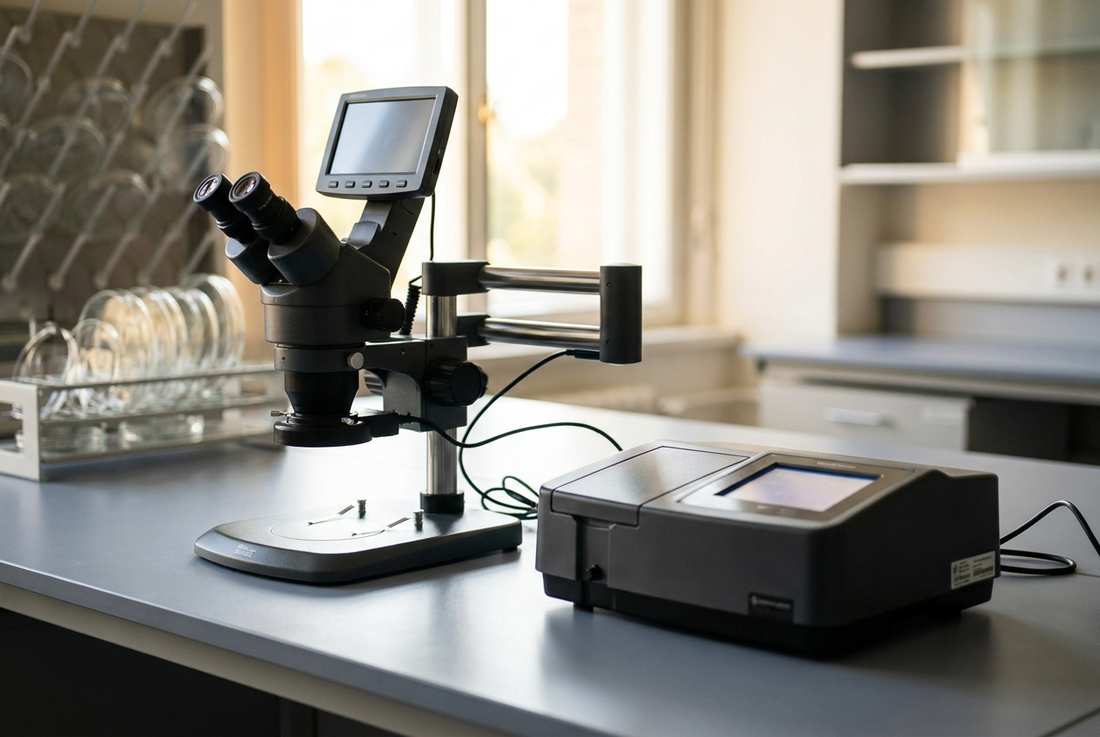
Stereo microscope and spectrophotometer on the laboratory bench
Measurement first, judgment second.

Instruments are honest about what they cannot do. No scanner calls color the way a trained eye does beside a master stone, and no algorithm maps an inclusion with the judgment of a grader at the microscope. So the laboratory runs both, in order.

The scan and the spectra come first, and they fix the facts: identity, geometry, weight, and type. Then the graders work: color against the master set under standardized light, clarity at the microscope with the plot drawn by hand, cut judged from the measured proportions. A second gemologist reviews every call independently. Where the two disagree, the stone is re-examined under supervision, and the re-examination decides.

The measured record and the graded record are stored together against the report number. That is what a client, an appraiser, or an insurer sees when they verify a report: not just the grades, but the fact that the grades were checked.

What each report includes

The same science supports every tier. The difference is how much of it prints on the document.

Analysis4Cs ReportCard ReportGrading Report
Identity testing & spectral screening
Carat, color, clarity, cut
Registry entry, same day
Polish, symmetry, fluorescence
Girdle inscriptionoptional
Measured proportions diagram
Plotted clarity characteristics
Light performance mapadd-onadd-on
Wallet cardadd-on

Put the instruments to work

Open a trade account and submit your first parcel under full chain-of-custody intake. Service terms and pricing within one business day.

Start Client Intake