Gemological grading for the lab-grown era Mon–Fri 9:00–5:00 ET New York Metropolitan Area Client Intake
Reports & Services

Jewelry Reports.

Complete documentation of a finished piece, written to travel with the jewelry from your counter to your customer’s insurer. The Jewelry Card Report is included.

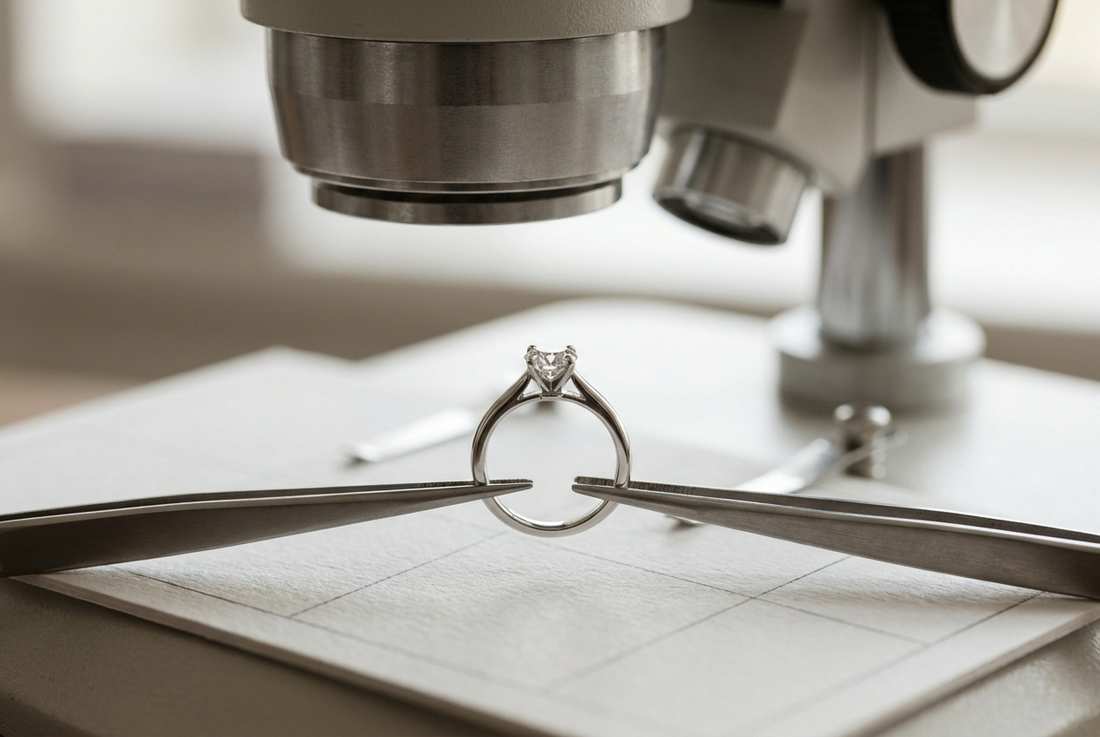
A solitaire ring held in tweezers above a grading pad
Every article is photographed at intake and examined stone by stone.

Documentation for finished jewelry

A finished piece is more than its center stone. The Jewelry Report documents the article as a whole: the center stone graded as the mounting permits, every side stone screened, the metal identified and its stamp verified, and the piece photographed as received.

The report is written for the piece’s life after the sale: the language your customer’s insurer and appraiser expect, with every qualification stated on the face of the document.

The examination

What happens to a piece between intake and report.

  1. Intake & photography

    The article is logged under dual control, weighed, measured, and photographed from standard angles. The photograph prints on the report and its card.

  2. Stone mapping

    Every stone position is counted and recorded, center and sides, before any testing begins.

  3. Center stone examination

    Identity testing and spectral screening, then grading: color against master stones as viewing angles allow, clarity at the microscope, weight calculated from measurements and stated as calculated.

  4. Side stone screening

    Each side stone is tested in place to confirm diamond identity, with any inconsistency flagged by position.

  5. Metal & findings

    The alloy is identified, the stamp is verified against the test result, and clasps or closures are noted where relevant to the article.

  6. Report, card & registry

    The report is issued with the Jewelry Card Report, and the record enters the registry the same day.

What the report states

ElementHow it is stated
Center stone identityConfirmed by instrument testing and spectral screening
Center stone gradesMinimum color and clarity as ranges, qualified as the mounting permits
Center stone weightCalculated from measurements, stated with its range
Side stonesCount, total calculated weight with range, and screening results
MetalAlloy identification and stamp verification
PhotographPrinted on the report and the Jewelry Card Report
RegistrySame-day entry under the report number
Common questions
Why are mounted grades stated as ranges?
A mounting hides parts of the stone and limits viewing angles. An honest laboratory states what it could verify: a minimum grade range and a calculated weight, each labeled as such. An exact-sounding number on a mounted stone is a guess wearing a suit.
Is the report an appraisal?
No. The report is a statement of gemological findings, not a valuation. Insurers and appraisers use it as the factual basis for their own figures.
Which articles are accepted?
Rings, bracelets, studs and earrings, pendants, and tennis necklaces. Unusual articles are reviewed at intake; ask client services before shipping.
Can I get a loose-stone report instead?
Yes, if the stone is submitted before setting. Once mounted, grading is qualified as the mounting permits; many clients certify the center stone loose and document the finished piece afterward.

Speak with the laboratory

Tell us about your goods and what you need documented. We respond within one business day.

Contact the Laboratory