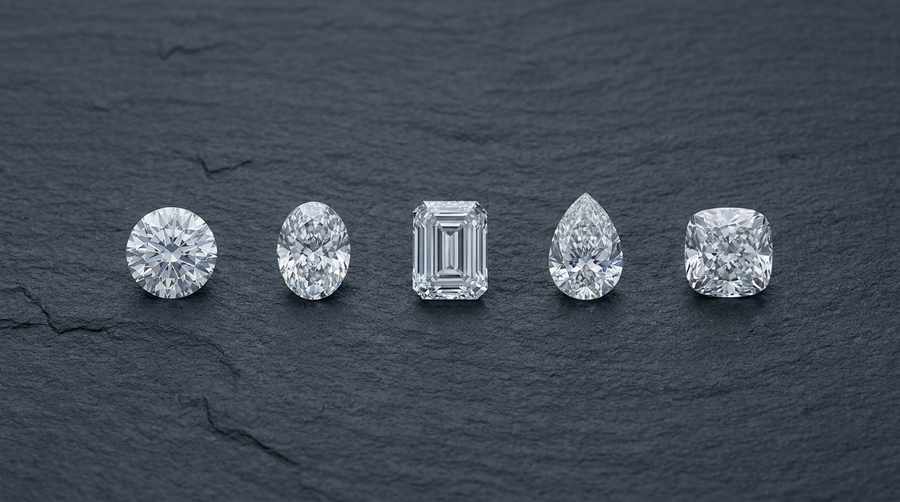
Most buyers meet the 4Cs as marketing. Here is what they mean on a grading bench, with the diagrams graders actually work from.
Every grade on a report refers to a specific part of the stone. The vocabulary below is how a grader, a cutter, and an appraiser describe the same diamond without ambiguity.
Cut grading measures these proportions to a tenth of a degree. For round brilliants, our Excellent range follows the internationally accepted windows:
| Measurement | Excellent range | What happens outside it |
|---|---|---|
| Table | 54 – 60% | Too large flattens fire; too small darkens the eye |
| Total depth | 59 – 63% | Carat weight hides in depth the eye never sees |
| Crown angle | 32 – 36° | Controls dispersion, the colored flashes |
| Pavilion angle | 40.6 – 41.8° | A single degree off leaks light out of the stone |
Cut is the only C that people fully control, and the one with the largest effect on beauty. The physics is unforgiving: light that enters the crown either returns to the eye or it doesn't:
The scale runs from D (colorless) to Z (visibly tinted). Grading is comparative: the stone sits beside master stones of known grade under standardized lighting, and the grader judges where it falls. Near the top of the scale the differences are subtle enough that they can only be called against masters, never from memory and never from a photograph.
Clarity grades describe the internal and surface characteristics visible at 10× magnification. Graders map what they find on a plot, and those inclusions double as the stone's fingerprint, confirming that a returning stone is the same one graded before.
Shape is not a grade, but every measurement on a report is read against the shape's expected geometry, and each shape carries a classic length-to-width ratio the trade considers well-proportioned.
Old and unusual cuts fell out of favor not because they are less beautiful, but because they are harder to grade and harder to mass-produce. A laboratory that measures geometry directly is not limited to the standard chart.
A laboratory-grown diamond is diamond: carbon crystallized in the same structure, with the same hardness, brilliance, and fire as a mined stone. The difference is origin: instead of forming over geological time, the crystal is grown in weeks, either under high pressure and high temperature (HPHT) or by chemical vapor deposition (CVD), in which carbon builds up layer by layer on a seed plate.
Because the material is identical, no gemologist can separate lab-grown from natural by eye, not with a loupe, not with experience. The separation is made by instruments that read a stone's physics. That fact sits at the center of everything a modern laboratory does.
The one-sentence version: a certificate that wasn't preceded by testing is a printout, not a report. Ask any laboratory, including ours, what was actually tested before the grades were written.
Confirm its details against the laboratory registry in seconds. Verification is free, for anyone, always.
Verify a Report